What's all the fuss about the 1.5 degrees C?
Bill Gates' How to Avoid a Climate Disaster, read by a meteorologist: 52 billion tonnes of greenhouse gases a year, and why renewables alone will not reach zero.
Climate · Climate change · Renewable energy · Book notes
How to avoid a climate disaster?
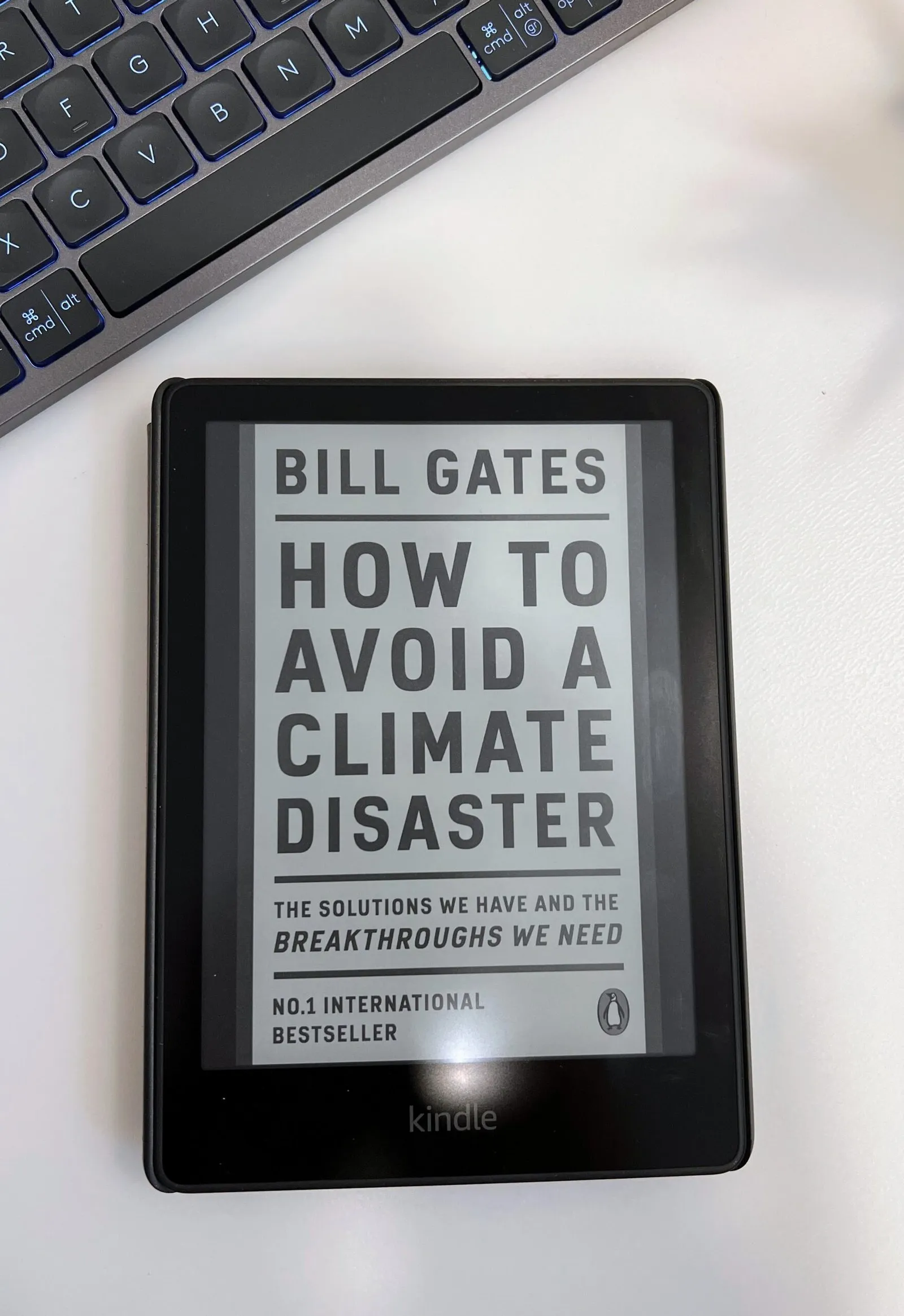
Everyone in my household has come down with the flu in the past few days. If you’re wondering how we did, it was terrible – thanks for your concern – but it allowed me to step away from day-to-day life and pick up one of the books I had wanted to read for a while: Bill Gates’ How to Avoid a Climate Disaster, published by Penguin in 2022.
Let me admit that I’m not a fan of a billionaire coming and telling the world how to live their lives. But I had become convinced that Bill G. was different from a typical billionaire. He could have invested his money to buy Twitter 😉 or joined some show of muscle such as the space race. Instead, Melinda and Bill have spent more than 50 billion dollars on charity work since 2000. They established the Bill & Melinda Gates Foundation, helping children and less privileged people worldwide by fighting diseases such as diarrhoea and pneumonia. I value and respect the gesture.
I wrote this book because I don’t just see the problem of climate change; I also see an opportunity to solve it.
— Bill Gates
30 million elephants per day!
The book is very well written and, right off the bat, gives you some facts and figures as food for thought. The central figure is 52 billion tonnes. If you followed some of the recent discussions around climate change, such as the Sharm el-Sheikh Climate Change Conference (COP27), you already know that we add around 52 billion tonnes of greenhouse gases (GHG) to the atmosphere every year. That is about 30 million elephants every single DAY!
This is where we are today. Just think about it for a moment …
Now, how could we get this number to ZERO? This second number is our aim: to stop the warming and avoid the worst effects of climate change. If getting from 30 million elephants of GHG a day down to zero sounds difficult, that’s because it is. If you’re one of the few climate change deniers or sceptics, I’ll be happy to dedicate a post to that – just let me know.
On the path to getting humanity out of the hole we dug for ourselves and avoiding a catastrophic disaster, three things are clear:
- We have to get to zero, or even below zero (more on that further down).
- The less complicated part: we need to change our consumption habits and expand renewable energy and the other relevant technologies we already have – but faster and wiser.
- The hardest part: we must create and deploy breakthrough technologies that can take CO2 out of the atmosphere.
Why do we need number three? Because changing our behaviour around fossil fuels and expanding the renewable energy network will not be enough. These days I watch a bit of German news every day to improve my German listening skills. If you just woke up from a year-long sleep: the main topics are the energy crisis in Europe and the war. Before that, for two years, the headline was COVID. I’m not an economist, but it’s not rocket science to predict that for the next few years it will be inflation and economic recovery after all these disasters. Climate change is not the general public’s primary concern, and people have developed a kind of climate change fatigue, if you will. Badly engineered climate campaigns, climate deniers’ propaganda and mixed messaging, on top of all these disasters, brought us to where we stand right now.
On the other hand, I believe extending today’s renewable energy technology to the Middle East and Africa currently has little business viability. Just look at this comparison:
Germany vs. Iran
| Germany | Iran | |
|---|---|---|
| Population | 84 million | 86 million |
| Annual budget | $930 billion | $30 billion |
| Energy consumption (toe = tonne of oil equivalent) | 3.4 toe/capita | 3.2 toe/capita |
| CO2 emissions | 7.8 tCO2/capita | 7.3 tCO2/capita |
| Share of renewables in total energy | 19.7% | less than 0.1% |
The table compares a well-developed country, Germany, with Iran, a developing country in the Middle East with roughly the same population and energy consumption. For simplicity, I’ve rounded some of the numbers. While energy consumption and headcount are about the same, Iran’s budget is roughly 30 times smaller. You might argue that sanctioned Iran is not a good example, but the truth is that most countries in the Middle East and Africa, one way or another, face economic difficulties.
Renewable energies have grown rapidly in Germany. Their share of gross final energy consumption reached 19.7% in 2021 (calculated per EU directive 2009/28/EC). The electricity sector is the main driver, with renewables already providing 41.1% of electricity consumption in 2021. The cost of the energy transition – moving from fossil fuels to renewables – has been a political hot potato since the early days of the so-called Energiewende. But the debate has shifted considerably in the last decade or so. While some early critics questioned the whole enterprise for economic reasons, Germany’s national climate targets and the Paris Agreement firmly established that doing nothing is no longer an option. The Energiewende gained legislative support in 2010, and Germany spent nearly 202 billion euros on renewable energy projects from 2013 to 2020. Since 2010, the share of German electricity generated from solar and wind has risen from 8% to 31% by 2020 – no small feat. To make a long story short: to cut its total fossil fuel consumption by roughly 10%, Germany invested around 200 billion dollars, about seven times Iran’s annual budget. No doubt Iran could use a good part of its uninhabited land to generate enormous amounts of solar energy, but that much investment for transitioning about 10% of its energy consumption is not feasible – at least not now.
Now back to 1.5 degrees C
So as much as we need a larger share of renewable energy – one that is more affordable and accessible for developing countries – it might not be enough to hit net-zero or near-net-zero targets. As Bill G. puts it, making electricity accounts for only 26% of all greenhouse gas emissions. Even with a huge breakthrough in batteries and other relevant technologies, we would still need to eliminate the other 74%.
We must find ways to create and deploy new technologies that actively reclaim greenhouse gases from the atmosphere to take us the rest of the way. The fact is that we have already emitted too much CO2. This much GHG puts us on a path where the Earth’s average temperature could rise by more than 2 degrees in 80 years or so. Unfortunately, only a few clearly understand what a 2-degree increase means, or how big a problem we are facing.
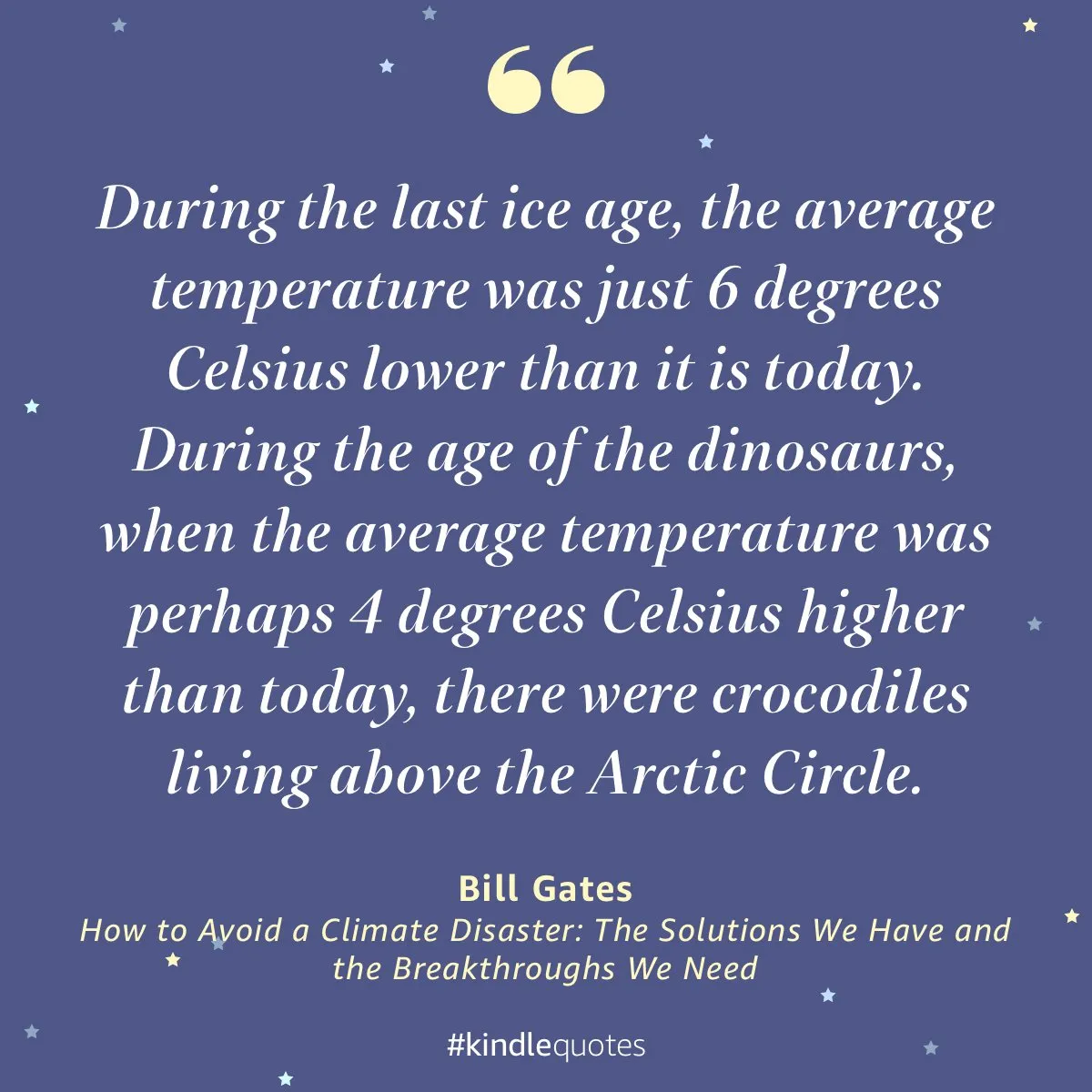
I already knew this, yet this passage from Gates’ book helped me appreciate the magnitude of the mess and the risk we face as a species. Bill writes that during the last ice age, the average temperature was just 6 degrees Celsius lower than it is today. During the age of the dinosaurs, when the average temperature was perhaps 4 degrees Celsius higher than today, crocodiles lived above the Arctic Circle. I’m not sure about you, but I’m going to print this and hang it in my living room 🙂
Just let it sink in for a moment, and you will appreciate what all this fuss is about. For the sake of our children and grandchildren, we must do what we can to clean up our mess. The ultimate goal is net-negative emissions: eventually taking more GHG out of the atmosphere than we put in. We are far from that goal, but Gates is optimistic in his book and believes it will be difficult but doable!
I still need to finish the book, but it has given me enough incentive to write about it. Once I’m done, I aim to summarise the book in another post. Congratulations and many thanks if you have made it this far – I hope it was worth your time!
